
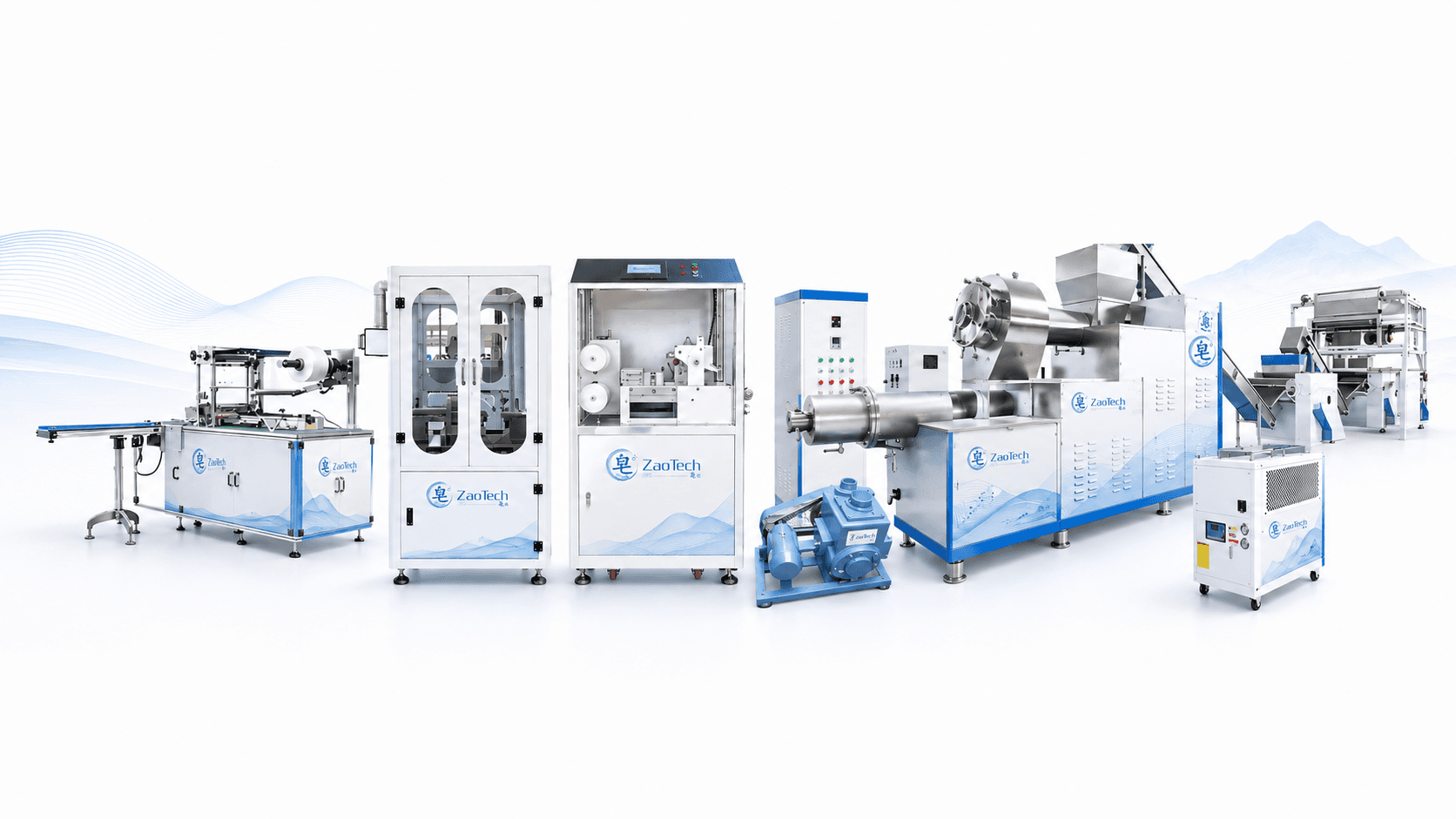
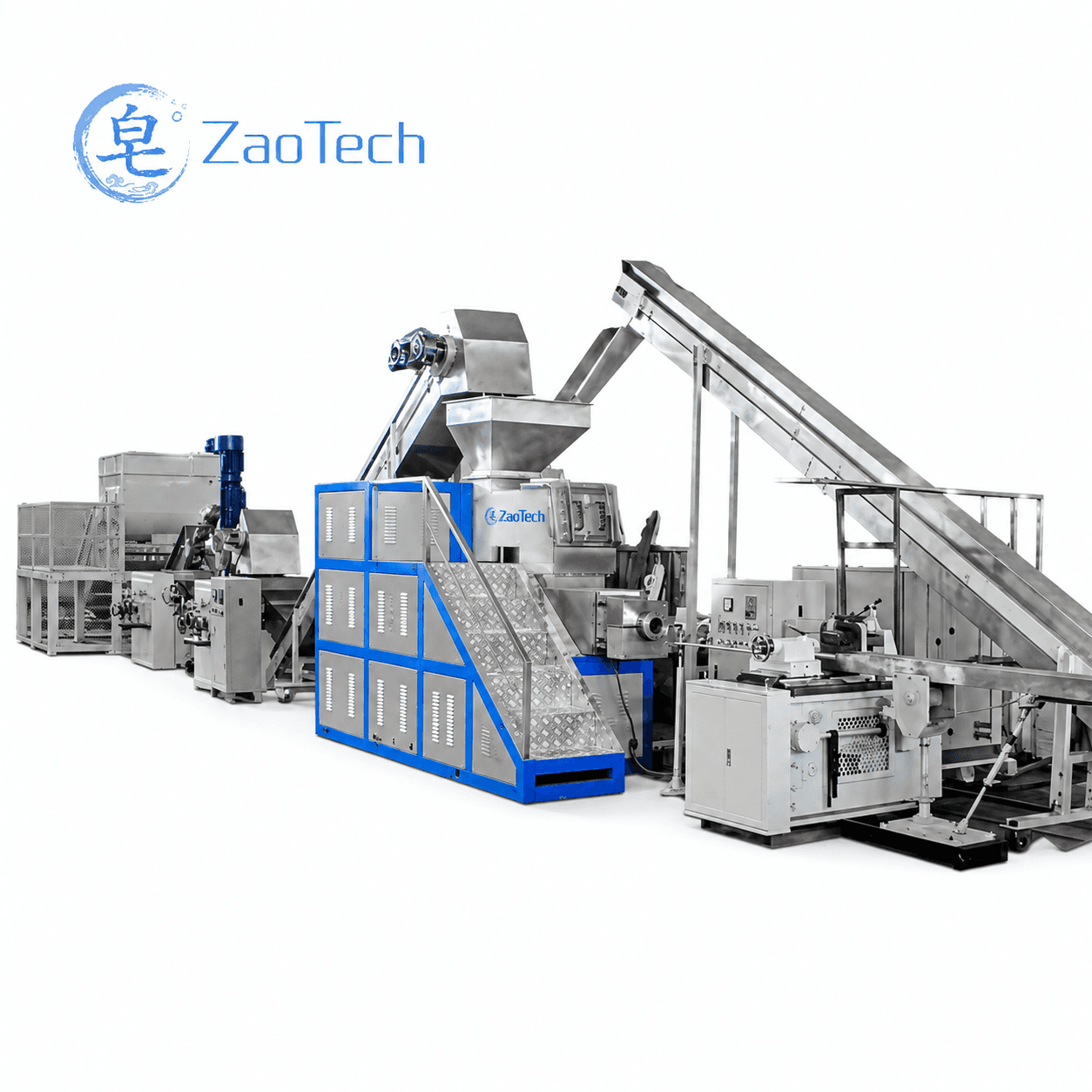
The ZAOTECH soap manufacturing plant is a heavy-duty toilet and bath bar finishing line rated up to 500 kg per hour. It takes refined soap noodles through Z-blade mixing, hardened-roller refining, vacuum plodding and high-speed stamping to deliver firm, well-coloured bars with crisp embossing. It is aimed at producers who have outgrown small finishing sets and need a robust line for steady commercial output.
This automatic soap manufacturing plant is built around durable industrial components: a 7.5 kW Z-type mixer, a cast-iron three-roller mill with hardened high-chrome rolls, a twin-stage vacuum plodder with heating, and an electromagnetic variable-speed stamper running 80 to 120 bars per minute. Bar weight is configurable from 50 to 200 g, with the shape and logo made to your design.
With soap noodles as the only feedstock, this soap manufacturing plant fits a workshop of about 50 m² and is operated by a small crew, making it a practical core line for toilet-soap and bath-bar brands moving into serious volume.
Key advantages of this toilet soap making machine
- Built for 500 kg/h duty. Heavy components throughout let this line run sustained toilet and bath-bar production without the bottlenecks of lighter finishing sets.
- Hardened refining rolls. The three-roller mill uses a cast-iron frame with high-chrome, hardened roll surfaces at a 1:3:9 speed ratio, giving fine, even soap and long roll life.
- Vacuum plodder with heating. A twin-stage worm plodder de-aerates and warms the soap, extruding a dense, smooth billet ideal for premium toilet bars.
- High-speed stamping. The electromagnetic, variable-speed stamper presses 80 to 120 bars per minute, matching the plant's throughput while keeping logos sharp.
- Configurable bar weight. Bars from 50 to 200 g are produced with your own shape and embossed logo, covering hotel, retail and gift formats.
- Hygienic contact surfaces. Soap-contact parts are stainless steel over rigid Q235 carbon-steel frames, balancing cleanliness with structural strength.
- Compact installation. The line fits a workshop of about 50 m² (10 × 5 × 3 m), excluding packing, so it slots into existing premises.
Technical specifications of the soap manufacturing plant
The figures below cover the four core machines of this soap manufacturing plant at 500 kg/h. Power, dimensions and weights are listed per machine so you can size foundations, power and floor space precisely.
| Machine | Key data | Power | Dimensions (mm) | Weight |
|---|---|---|---|---|
| Z-blade mixer | 100 kg/batch, 5 min, 33 rpm, Ø880 mm | 7.5 kW | 2300 × 842 × 1160 | — |
| Three-roller mill | Roll Ø260 mm, length 685 mm, ratio 1:3:9 | 11 kW | 1670 × 1450 × 1100 | ≈ 2280 kg |
| Vacuum plodder | 500 kg/h, worm Ø204 mm, 18 / 10–18 rpm | 11 + 15 kW | 3140 × 1350 × 2530 | ≈ 4000 kg |
| Cutter & stamper | 80–120 pcs/min, bar 50–200 g | 3 kW (electromagnetic) | 1500 × 950 × 1300 | ≈ 2000 kg |
| Plodder vacuum pump | 1.1 kW, plus 1 kW heating device | |||
| Total capacity | 0–500 kg/h | |||
| Workshop area | ≥ 50 m² (10 × 5 × 3 m) | |||
| Power supply | ≈ 25 kW class, 380 V, 50 Hz | |||
| Operators | 2–4 persons | |||
Throughput and bar formats
Rated up to 500 kg per hour, this soap manufacturing plant suits brands producing toilet and bath bars in steady commercial volumes. The stamper's 80 to 120 bars per minute and the 50 to 200 g weight range together let you switch between small guest soaps, standard retail bars and larger premium formats with a die and recipe change.
The hardened mill and vacuum plodder are what set this line apart from lighter equipment: they deliver the fine texture and dense body expected of toilet soap, so the finished bar feels solid in the hand and carries a clean, sharply defined logo.
Applications and industries for the automatic soap manufacturing plant
This soap manufacturing plant is built for producers of toilet and bath bars: retail soap brands, hotel and hospitality suppliers, and contract manufacturers running private-label cosmetic bars. Its robust components make it a dependable core line where uptime and consistent quality matter.
Typical products include scented toilet soaps, beauty and bath bars, and hotel guest soaps, all finished from purchased soap noodles. The plant works on its own from bought-in noodles, or as the finishing end of a fuller factory fed by a soap saponification machine. Browse related equipment on the soap production lines page.
Because bar weight, shape and logo are all configurable, one plant can serve several brands or product tiers, which is attractive to contract manufacturers and growing private-label operations.
Compatible raw materials
The plant runs on refined soap noodles, with pigment and fragrance dosed in the mixer to set colour and scent. Skin-friendly additives and colour pastes can be blended in to suit cosmetic and bath formulations.
| Material | Role in the bar |
|---|---|
| Soap noodles | Base soap for toilet and bath bars |
| Pigment / colour paste | Bar colour and brand look |
| Fragrance | Scent profile |
| Cosmetic additives (optional) | Skin-care and finish properties |
How the soap manufacturing plant works
- Mixing. Soap noodles, colour and fragrance are blended in the Z-blade mixer in roughly 5-minute, 100 kg batches.
- Refining. The hardened three-roller mill grinds the blend to a fine, even soap and disperses additives uniformly.
- Plodding. The twin-stage vacuum plodder warms and de-airs the soap, extruding a dense, smooth billet.
- Cutting. The billet is cut to the chosen bar size at line speed.
- Stamping. The electromagnetic stamper presses 80–120 bars per minute, embossing your logo and final shape.
Bar quality and durability
Final bar quality on this soap manufacturing plant comes from the combination of hardened-roll milling and heated vacuum plodding. Fine milling removes graininess and spreads colour evenly, while the de-aerated, warm soap forms a hard bar with clean faces and a crisp embossed logo.
The heavy frames and substantial machine weights also matter in service: a rigid, well-anchored line runs with less vibration, which protects finish quality and component life over long production shifts.
Component strength and uptime
This soap manufacturing plant is specified with heavier machines than entry-level finishing sets, and that weight is deliberate. The roughly 2280 kg three-roller mill and 4000 kg vacuum plodder give the rigidity needed for sustained 500 kg/h running, resisting the vibration that erodes finish quality on lighter equipment.
The hardened, high-chrome mill rolls are chosen for wear life, since refining is the most abrasive duty in the line. Combined with the heated, twin-stage plodder, they help the soap manufacturing plant hold consistent bar quality through long shifts rather than only short runs.
For a brand investing in serious toilet-soap capacity, that robustness translates into uptime and lower maintenance disruption, which often separates a profitable line from a troublesome one.
Frequently asked questions about the soap manufacturing plant
What output does this soap manufacturing plant reach?
It is rated up to 500 kg per hour, with the stamper producing 80 to 120 bars per minute depending on bar size.
Is it for toilet soap, laundry soap, or both?
The line is configured for toilet and bath bars, where the hardened mill and vacuum plodder give the dense, fine finish those products require.
What bar weights can it make?
Bar weight is configurable from 50 to 200 g, with your own shape and logo set by the stamping die.
Does it make soap from oil?
No. It is a finishing plant fed with soap noodles. Add a saponification stage upstream to produce noodles from raw oils.
How much space and power are needed?
The line fits a workshop of about 50 m² (10 × 5 × 3 m) and runs on a 380 V, 50 Hz supply in the 25 kW class.
How many people operate it?
Two to four operators are typical for the full mixing-to-stamping sequence.
How many bars per minute does the stamper produce?
The electromagnetic, variable-speed stamper presses 80 to 120 bars per minute, set to suit the bar size and running speed.
Can it run continuously through a full shift?
Yes. Its heavy components and anchored frames are designed for sustained production rather than only short batches.
Is it suitable for cosmetic-grade toilet soap?
Yes. Fine milling and heated vacuum plodding give the smooth, dense body and sharp embossing expected of cosmetic bars.
What is the Z-blade mixer's batch size?
The Z-blade mixer handles about 100 kg per five-minute batch, feeding the mill steadily.
How fine does the three-roller mill grind?
Its hardened, high-chrome rolls reduce the soap to a fine, even texture suited to quality toilet bars.
What bar weights can it produce?
The stamper and cutter handle bars from roughly 50 to 200 g, set by your die and cut length.
Why choose the ZAOTECH soap manufacturing plant?
- Heavy-duty components. Hardened rolls, a twin-stage plodder and a high-speed stamper are built for sustained 500 kg/h production.
- Premium bar finish. Fine milling and heated vacuum plodding deliver dense bars with sharp, clean embossing.
- Configurable products. Bar weight, shape and logo are all set to your design across multiple product tiers.
- Compact and integrable. A small footprint and clean interfaces let it stand alone or join a fuller ZAOTECH factory.
- Low crew, steady output. A two-to-four-person team runs the plant at consistent commercial volume.
For brands scaling up toilet and bath-bar output, this ZAOTECH soap manufacturing plant offers a robust, fully configurable finishing line that turns soap noodles into premium, market-ready bars.