
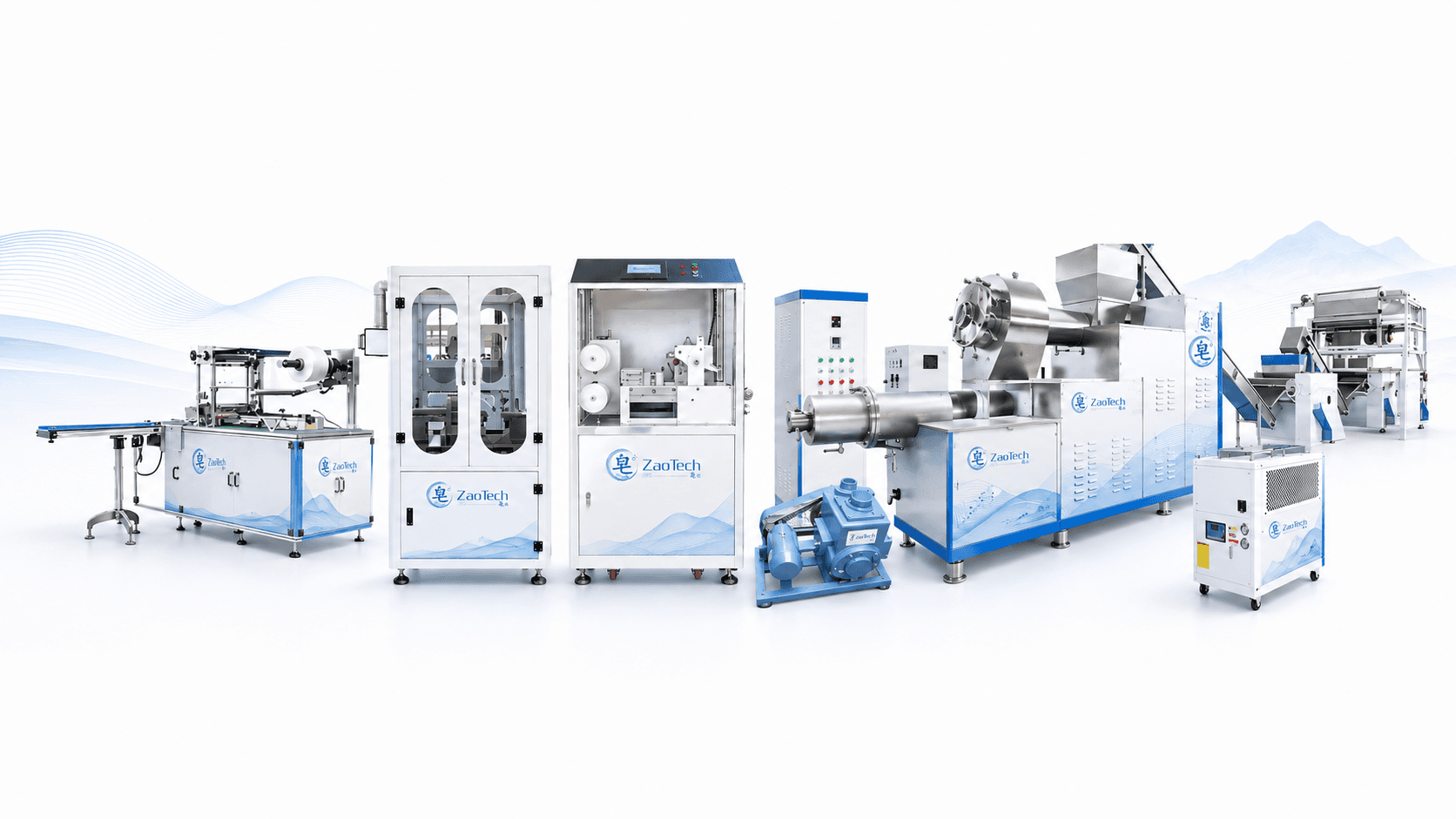
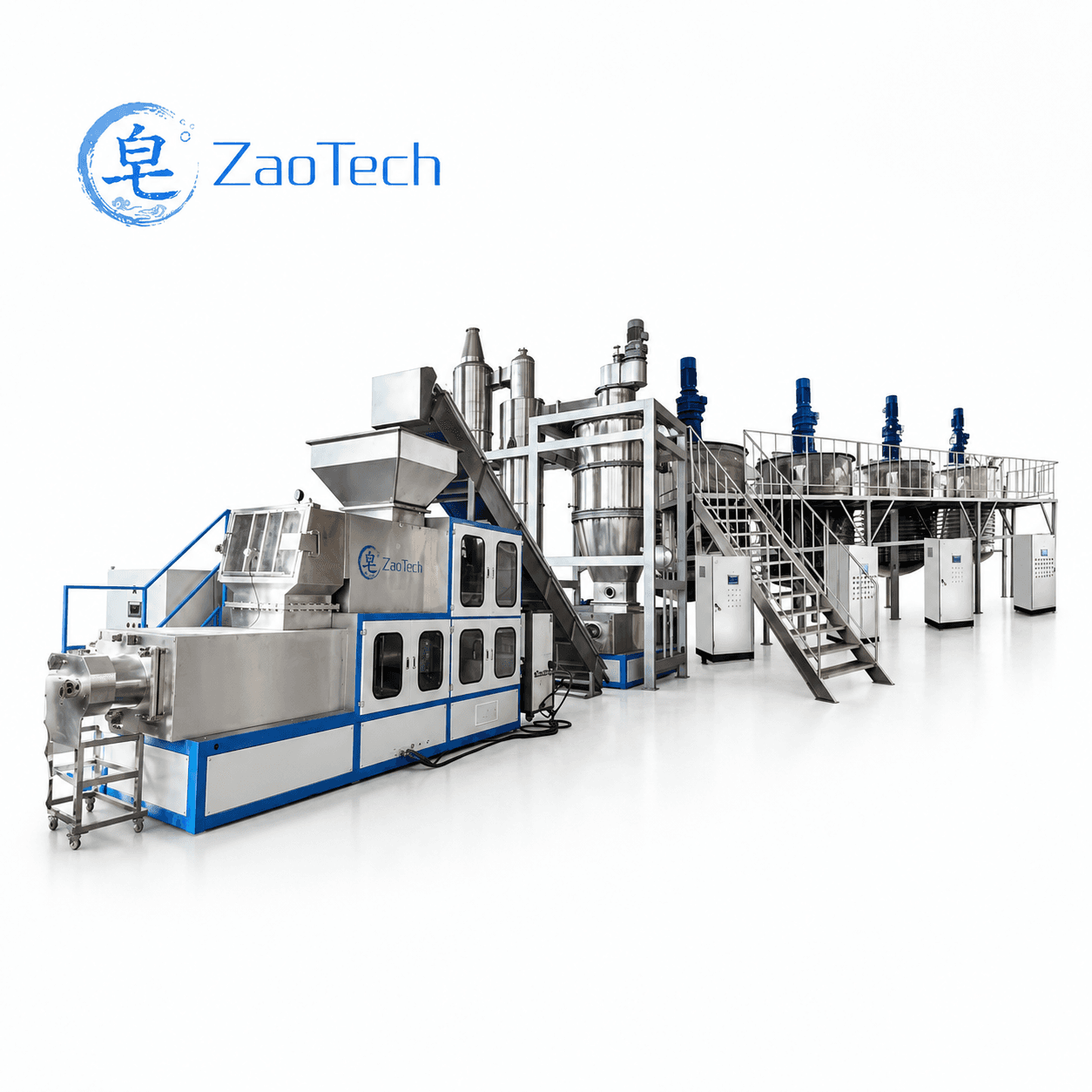
The ZAOTECH laundry bar soap line is a complete, all-stainless system that takes palm oil and palm kernel oil through oil-based saponification and neutralization and out the other end as finished solid laundry bars. Rated for 1000 to 2000 kg per hour, it is a single integrated line covering oil melting, saponifying, vacuum drying and cooling, noodle milling, vacuum extruding, and stamping and cutting.
Built on oil based saponification, the line reacts oils with alkali and neutralizes the soap mass without a water-draining stage, then dries it under vacuum to the right moisture for milling. Because the whole machine is stainless steel, it holds up to hot soap and alkali while staying clean across long, high-volume production runs.
Where a saponification stage alone delivers soap noodles, this laundry bar soap line is engineered to deliver the finished product: market-ready solid laundry bars, made end-to-end from raw oil under one continuous flow.
Key advantages of this oil based saponification line
- Complete oil-to-bar line. One integrated system melts oil, saponifies and neutralizes, dries, mills, extrudes, stamps and cuts, so you produce finished laundry bars rather than just soap base.
- High capacity. Rated 1000 to 2000 kg per hour, the line suits large laundry-soap producers and exporters.
- All-stainless construction. A fully stainless-steel build resists hot soap and caustic soda and supports clean, long-running production.
- Saponification and neutralization. The process both saponifies the oils and neutralizes the soap mass, giving a stable, well-balanced bar.
- No water-draining. Soap and glycerine stay together through the process, reducing losses and effluent.
- Vacuum drying and extruding. Vacuum drying sets a firm, low-moisture noodle and vacuum extruding produces a dense bar billet that holds a crisp stamp.
- Palm-based feedstock. Optimised for palm oil and palm kernel oil, the most common and cost-effective laundry-soap base.
Technical specifications of the laundry bar soap line
The table summarises the configuration of this laundry bar soap line. Use it alongside a site layout to plan utilities and the process hall for a high-capacity, continuous installation.
| Parameter | Specification |
|---|---|
| Line type | Complete soap production line, oil to finished bar |
| Capacity | 1000–2000 kg/h |
| Machine material | Stainless steel |
| Raw materials | Palm oil and palm kernel oil |
| Process | Saponification and neutralization, no water-draining |
| Drying | Vacuum drying and cooling |
| Shaping | Noodle milling, vacuum extruding, stamping, cutting |
| End product | Solid laundry bar soap |
Capacity and end product
At 1000 to 2000 kg per hour, this laundry bar soap line is sized for serious commercial and export volumes. The output is a finished, stamped solid laundry bar rather than an intermediate, which makes the line attractive to producers who want to ship a packaged-ready product directly from their own plant.
Bar shape, weight and embossed logo are formed at the stamping and cutting stage, so a single line can produce several laundry-bar formats. Working from palm oil and palm kernel oil keeps the raw-material base simple and economical at this scale.
Applications and industries for the laundry soap plant
This laundry bar soap line is built for large producers of solid laundry soap: established manufacturers, palm-oil processors integrating into finished goods, and exporters supplying laundry bars in volume. Its all-stainless build and continuous flow make it a dependable backbone for high-output operations.
Typical products are standard and economy laundry bars made from palm-based oils. The line stands alone as a complete plant, and it sits naturally alongside other ZAOTECH equipment such as a continuous saponification plant within a larger site. The full range is shown on the soap production lines overview.
For buyers focused on consistent, large-scale laundry-bar supply, owning the complete oil-to-bar process simplifies quality control and removes reliance on purchased soap base.
Compatible oils and chemistry
The line runs on palm oil and palm kernel oil, converted through saponification and neutralization into a stable solid soap. Colour and fragrance can be introduced during finishing to suit the target laundry-bar product.
| Input | Role |
|---|---|
| Palm oil | Primary fatty base |
| Palm kernel oil | Lather and hardness profile |
| Caustic soda | Alkali for saponification |
| Colour / fragrance (optional) | Finished-bar appearance and scent |
How the laundry bar soap line works
- Oil melting. Palm oil and palm kernel oil are melted and fed into the reaction stage.
- Saponification and neutralization. Oils react with alkali and the soap mass is neutralized, with no water-draining.
- Vacuum drying and cooling. The soap is dried and cooled under vacuum to milling moisture.
- Milling. The dried soap is milled into uniform noodles.
- Vacuum extruding. Noodles are compacted and extruded into a dense bar billet.
- Stamping and cutting. The billet is stamped and cut into finished laundry bars.
Build quality and finished-bar consistency
The stainless construction of this laundry bar soap line is more than a hygiene feature: it keeps the wetted path stable under hot soap and alkali, which protects both the process and the equipment over high-volume runs. Vacuum drying and extruding then lock in low moisture and density.
The result is a hard, uniform laundry bar with clean faces and a sharp embossed logo, reproduced consistently batch after batch, shift after shift, across the line's full capacity range.
Why a complete oil-to-bar line
The case for this laundry bar soap line is integration. By combining saponification, neutralization, drying, milling, extruding and stamping in one stainless system, it removes the gaps between separate machines and the handling losses that come with them, so material moves straight from oil to finished bar.
That integration also concentrates quality control. With the whole process under one roof and one recipe, a producer can hold the oil blend, alkali ratio and moisture steady, which is what keeps a high-volume laundry bar consistent across very large runs.
For exporters in particular, owning the complete line simplifies certification and standardisation, since every step from raw palm oil to the stamped bar is in-house rather than spread across suppliers.
In day-to-day terms, an integrated laundry bar soap line also shortens the learning curve for operators. With one control philosophy across saponification, drying and finishing, a single trained team can run the whole line rather than coordinating separate crews on standalone machines, which helps a large plant keep output steady shift after shift.
Frequently asked questions about the laundry bar soap line
Does this laundry bar soap line make bars directly from oil?
Yes. It is a complete line that starts with palm oil and palm kernel oil and ends with finished, stamped solid laundry bars.
What is the difference from a saponification-only machine?
A saponification machine produces soap base and noodles. This line adds drying, milling, extruding, stamping and cutting to deliver finished bars in one flow.
What capacity is available?
The line is rated for 1000 to 2000 kg per hour, suiting large-scale and export production.
Why is the line made entirely of stainless steel?
Stainless steel resists hot soap and caustic soda, keeps the process clean, and supports long, continuous production without contamination.
Which oils does it use?
It is optimised for palm oil and palm kernel oil, a common and economical base for solid laundry soap.
What does the neutralization step do?
Neutralization balances the saponified soap mass, helping produce a stable, consistent finished bar.
Does this laundry bar soap line need a separate finishing line?
No. It already includes milling, extruding, stamping and cutting, so it delivers finished bars without a separate finishing line.
What output is realistic in practice?
The line is rated for 1000 to 2000 kg per hour; real throughput depends on bar size, oil blend and how steadily the line is fed.
Can colour and fragrance be added?
Yes. Colour and fragrance can be introduced during finishing to suit the target laundry-bar product.
Why is stainless steel important here?
The wetted path handles hot soap and caustic soda, so a stainless build keeps the laundry bar soap line clean and durable over long runs.
Which oils does the line use?
It is optimised for palm oil and palm kernel oil, a common and economical base for solid laundry bars.
Is the whole line stainless steel?
Yes. The laundry bar soap line is built in stainless steel to handle hot soap and caustic soda cleanly.
Can it make different bar sizes?
Yes. Bar shape, weight and logo are set at the stamping and cutting stage, so several formats are possible.
What crew is needed?
As a continuous, largely automated line, it is run by a small trained team rather than a large workforce.
Does it include drying?
Yes. Vacuum drying and cooling are part of the line, setting firm, low-moisture noodles before extrusion.
Why choose the ZAOTECH laundry bar soap line?
- Finished product, not just base. One line carries raw oil through to stamped solid laundry bars.
- High, continuous capacity. 1000–2000 kg/h for large and export-scale producers.
- All-stainless build. Clean, durable wetted path for hot soap and alkali.
- Efficient chemistry. Saponification, neutralization and no water-draining keep losses low.
- Consistent bars. Vacuum drying and extruding deliver hard, uniform, sharply stamped laundry soap.
For high-volume laundry-soap manufacturing, this ZAOTECH laundry bar soap line provides a complete, all-stainless route from palm oil to finished, market-ready bars under one continuous process.